Too hot to taste chocolate? Sit back and take the Appreciation of Fine Chocolate on-demand video course, a fascinating guide to the world of fine chocolate.
This is the third article in a series examining the distinctions between industrial premium chocolate and fine or craft chocolate—from flavour and sourcing to transparency and intent.
This particular comparison was sparked by a simple question someone asked me after seeing the Cox & Co logo: “Is farm to bar better than bean to bar?”
My answer, of course, was: “It all depends!”
All chocolate starts on a farm, or more often, on multiple farms, and ends up in a bar. Tracing its journey is important but how clearly that path is traced and communicated can differ significantly.
Our comparison this time focuses on two bars made with cacao grown in Colombia: a Cox & Co 71% Colombia dark; and Nicola's Chocolate 70% Colombia.
Both bars highlight origin and craft, but how deep does the traceability go—and how much does it really tell us?
First, let’s remind ourselves of the three key types of chocolate as this is our first clue to the value of their promises:
Confectionery chocolate: In our everyday chocolate, the origin of the cacao is often unknown, and largely irrelevant to most consumers. So, we are not dealing with confectionery here.
Industrial premium chocolate: A step up in price, often with selling points based on origin and sustainability. This category leans heavily on the marketing appeal of ethical claims, though what that actually offer can vary widely.
Fine (or craft) chocolate: Here, origin and sourcing are integral to the maker’s craft. The goal isn’t just ethical sourcing, it’s to bring out the unique character and flavour of the specific cocoa beans, with transparency from farm to bar.
The companies and brands themselves are our next clue.
Cox & Co presents itself as a brand with a conscience: “a treat you can feel great about enjoying.” The founder, Gavin Cox, tells us that he spent time in South America and wanted to create chocolate “as ethically as possible.”
Cox & Co is owned by Montrose Chocolate Ventures Ltd, a company that also manufactures white-label chocolate for other brands. (THE DD Team, n.d.) In other words, Cox & Co is a brand rather than a chocolate maker or manufacturer but the storytelling is compelling, and the brand positioning strong.
The traceable sourcing that Cox & Co points to, is the work of their supplier Luker Chocolate, a Colombian B Corp certified company who offer “premium” chocolate products to manufacturers. They claim to prioritise the well-being of cocoa farmers, consumers, and the environment. Luker Chocolate's cacao comes from 15,000 farmers located in the main growing areas of Colombia. They have created a sustainability platform and traceability system called Luker Trace to trace their cacao back to either farm, regional buyer or association. (Cox & Co, n.d.) According to CocoaRadar they have the goal of achieving full traceability to farm level by 2027. (Myers, 2025). You can download a copy of their 2024 Sustainability Progress Report from their website and read their progress for yourself. (Luker Chocolate, 2024)
Nicola’s Chocolate
Nicola’s Chocolate is as transparent and personal as it gets. Based in Exeter, Nicola is a one-woman chocolate maker, educator, former teacher and passionate advocate for craft chocolate. She makes her bars in small batches, from bean to bar, using fine-flavour cacao.
“I created Nicola’s: a brand that reflects my hands-on approach, my dedication to the craft, and my desire to build a chocolate community where people can connect with the process, the flavours, and the stories behind each bar,” she writes. And it’s not just marketing. Nicola has just opened a shop where customers can talk to her directly—about the beans, the farms, the flavours, and the making.
Her approach is deeply rooted in both ethics and education: “Chocolate isn’t just a sweet treat – it’s an adventure.” Her branding is very well executed and focuses on flavour, origin, and process. (Nicola's Chocolate, 2025)
Let’s look at the bars themselves.
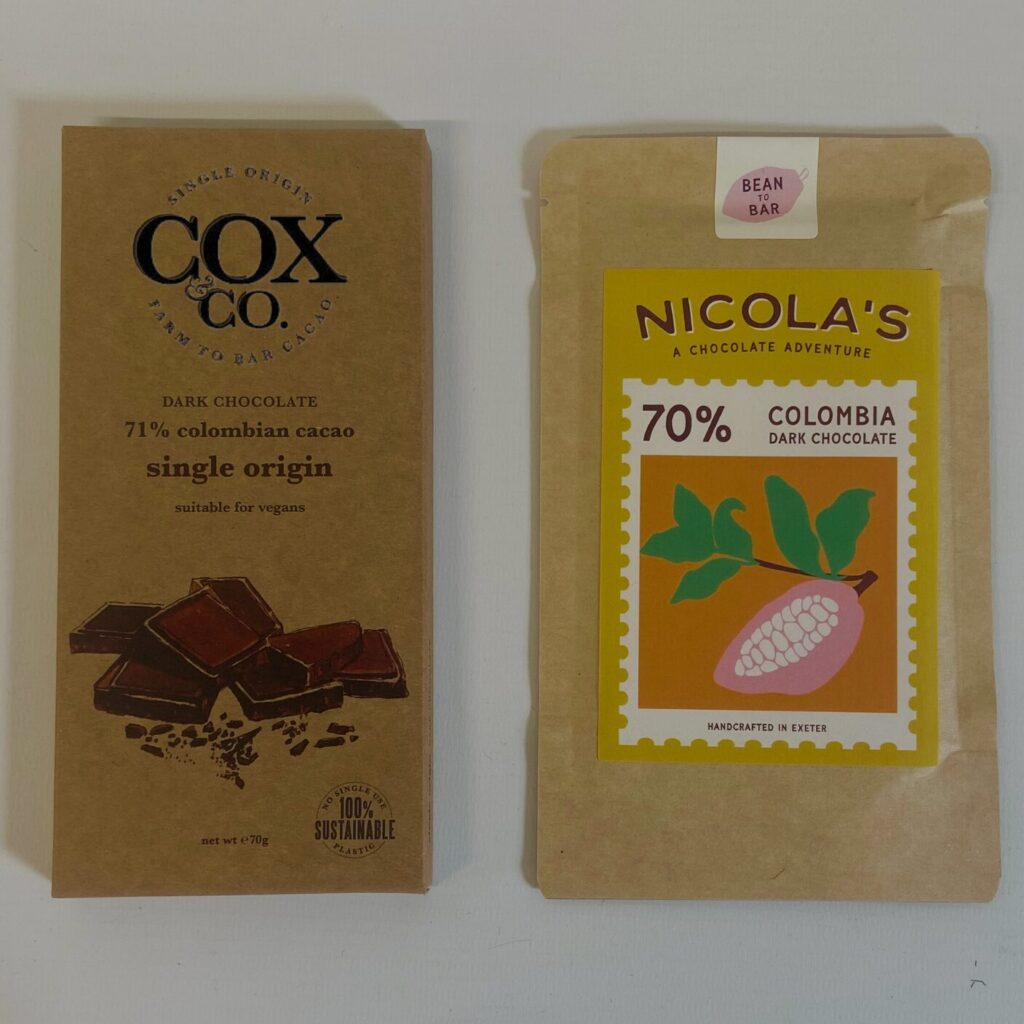
The 71% Colombian Cacao Single Origin Dark Chocolate from Cox & Co was purchased as part of a Mixed Bar Bundle (3 x 70g for £14), as it’s not available individually. My bar came from Batch 24245, with a best before date of 02.09.26.
The 70% Colombia Dark Chocolate from Nicola’s Chocolate was bought directly from her website at £5.65 for 50g. It came from Batch 00000009, with a best before date of 24.05.26.

Now let’s apply our three assessment criteria to evaluate the fineness of these chocolates: Taste, Transparency, and Craftsmanship. These aren’t just aesthetic categories, they reflect how much we really know about the cocoa beans and how they’ve been handled. For the purposes of this post, I’ll save taste for last, and begin with transparency.
This is where the gap between fine and fashionable chocolate widens. Both bars are made with Colombian cacao, but the level of transparency around that cacao, and how it is turned into chocolate, differs significantly.
Cox & Co 71% Colombia - “Farm to Bar Cacao”
Cox & Co claims its chocolate is made with farm to bar cacao supplied by Casa Luker in Colombia. While the packaging uses phrases like single origin, the “Casa Luker estate,” working with “local farmers” this is a broad simplification. Luker tell us that they purchase cacao from around 15,000 farmers across Colombia, drawing from multiple regions including Santander, Arauca, Huila, and Tumaco. In fact, Luker buys approximately 35% of Colombia’s cocoa production—more than 16,000 tons per month. No indication is given as to the genetics of the cacao or how the cacao is handled post-harvest we are just told it is a “blend” of Colombian cacao. The term “estate” could come from Granja Luker but this is a research and training facility and unlikely to be the origin of the cacao in the bar. So not a single estate bar, not even a single region bar, but the result of a national-scale supply network. (Luker Chocolate, n.d.)
As for the chocolate-making, it is described as “handcrafted in the UK for Cox & Co”. At least they are not claiming to make it, but you have to find the Montrose Ventures Ltd website to discover where the chocolate is produced and that Cox & Co is one of their brands. (THE DD Team, n.d.). So do Montrose Ventures Ltd make it from bean to bar then? They don't say. Videos and other public content focus on packaging, not chocolate production. So, the likelihood is that the finished couverture or semi-processed chocolate arrives from Luker and is then moulded and packed in the UK by Montrose.
So where is the transparency? In fine chocolate terms, the use of “farm-to-bar” refers to a chocolate maker who controls the entire farm to bar process from the farming of the cacao and post-harvest processes to the crafting from the raw beans to the finished bar, with full transparency. This is not the case here, all we know is that the cacao can be traced back to Luker’s supply chain in Colombia.
So, for Cox & Co there is no direct relationship between them and the farm or the process from farm to bar and they are not openly transparent about who actually makes the chocolate.
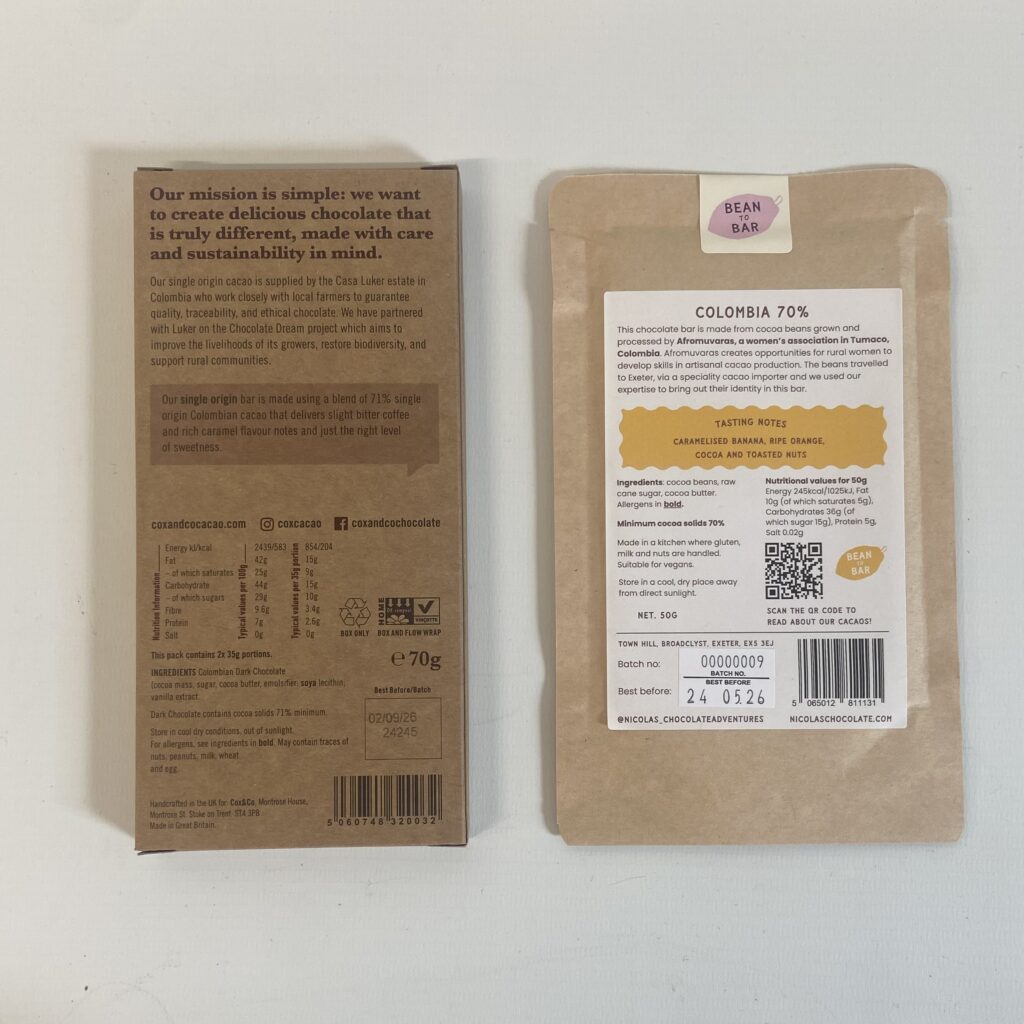
Nicola’s Chocolate, 70% Colombia – “Bean to Bar”
By contrast, Nicola’s transparency is integral to her brand. Her website and social media give detailed insights into the beans she uses,in this case, cocoa grown by Afromuvaras, a women’s association in Las Varas De Tumaco, Nariño, Colombia comprising 366 women who are improving lives in a region that has suffered the consequences of coca cultivation and trafficking. (Afromuvaras Association, 2025)
Nicola imports through “a specialist in fine cacao”. When asked directly who her importer was, she answered: Belco. There’s no supply chain opacity, just direct answers. Belco provides full post-harvest information—manual, selective harvest; fermentation in boxes; drying on raised beds, along with genetic classification (as far as possible). (Belco, n.d.)
Nicola roasts, stone-grinds, conches, and tempers the chocolate herself in her Exeter workshop. She regularly shares process photos and insights, and is open about ingredient sourcing, and even her own learning curve. Full Transparency not just traceability.
Cox & Co, 71% Colombia –“Handcrafted”?
Cox & Co describes its bars as “handcrafted in the UK,” but we also know that the facility producing these bars (Montrose Chocolate Ventures Ltd) reportedly has the capacity to make over 20,000 bars per day. So “handcrafted” is feeling a little more like marketing than reality. It's possible human hands are involved in moulding or packaging, but this isn’t small-batch, hands-on bean-to-bar chocolate-making. (THE DD Team, n.d.) I should point out that this is not a claim that Cox & Co make, but there are retailers who do it on their behalf. Connectionaffection.net in Stroud for example currently describe the Cox & Co 100% bar as “Small Batch, Bean to bar made cacao from the Luker Chocolate Estate” (Confection Affection, n.d.) - this is how AI rumours start!
By using a blend, Luker Chocolate is achieving a standardised flavour, essential for industrial and premium chocolate brands. As highlighted by The Chocolate Journalist, Luker excels at delivering consistency, which is crucial for large-scale chocolate production. (Chocolate Journalist, 2017) But this is flavour development in the industrial sense: controlled, efficient and replicable.
When we look at the ingredients, predictably, we see the use of vanilla extract to enhance the flavour: Dark Colombian Chocolate (cocoa mass, sugar, cocoa butter, emulsifier: soya lecithin, vanilla extract). It is pre-processed and remoulded chocolate with added flavour.
Nicola’s Chocolate, 70% Colombia – Small Batch, Start to Finish
Nicola’s approach couldn’t be more different. In her Exeter workshop, she makes chocolate from bean to bar, and her goal isn’t standardisation, it’s expression. She adjusts roast profiles and refining times based on the character of each batch, aiming to bring out the identity of the beans, not to standardise it.
The transparency in the sourcing, fermentation, and production is part of the craftsmanship too. It isn’t just ethical; it’s flavour-driven. Nicola communicates the sourcing information to show the care and respect involved in crafting natural flavours, as well as to honour the people whose skill and labour shape the cacao long before it reaches her.
The simplicity of the recipe places the full responsibility on the quality of the beans and the maker’s skill in bringing them to life.
Cox & Co 71% Colombia - A Treat
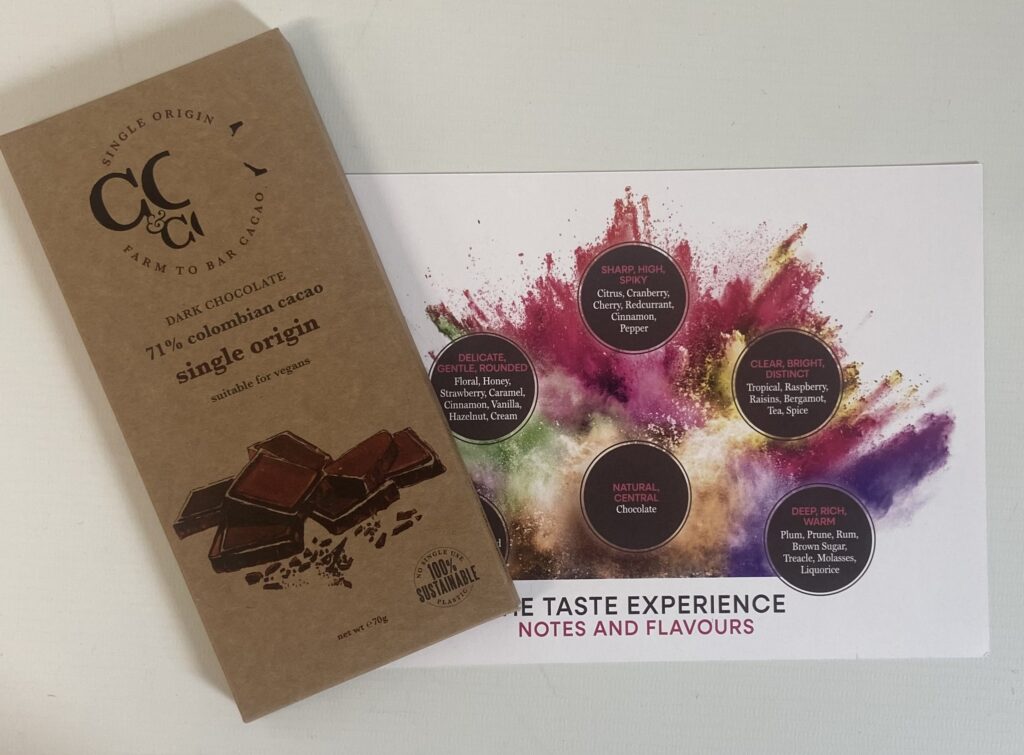
The bar promises “a slight bitter coffee and rich caramel flavour notes and just the right level of sweetness.”
The aroma was that familiar smell of vanilla with a slight off oil note. That said, I am approaching this bar as a trained taster, not everyone is going to smell first, they may just be going straight in for the munch! And to its credit, it tasted better than it smelled. The melt is even and pleasantly creamy at first. The vanilla delivers the promised sweetness, followed by an alkalised cocoa-powder note that might be interpreted as bitter coffee. The finish was a little dry with a metallic edge, but not aggressive. I wouldn’t choose to eat it myself, but it is safe, and familiar. That impression was confirmed when I offered it to a few people who aren’t used to fine chocolate—they found it 'not bad."
But while it delivers on approachability, it lacks complexity. The flavours are flat, one-dimensional, and ultimately unremarkable. Still, it’s well-executed for what Luker Chocolate aims to deliver: a premium chocolate.
Nicola’s Chocolate, 70% Colombia - A Taste Adventure
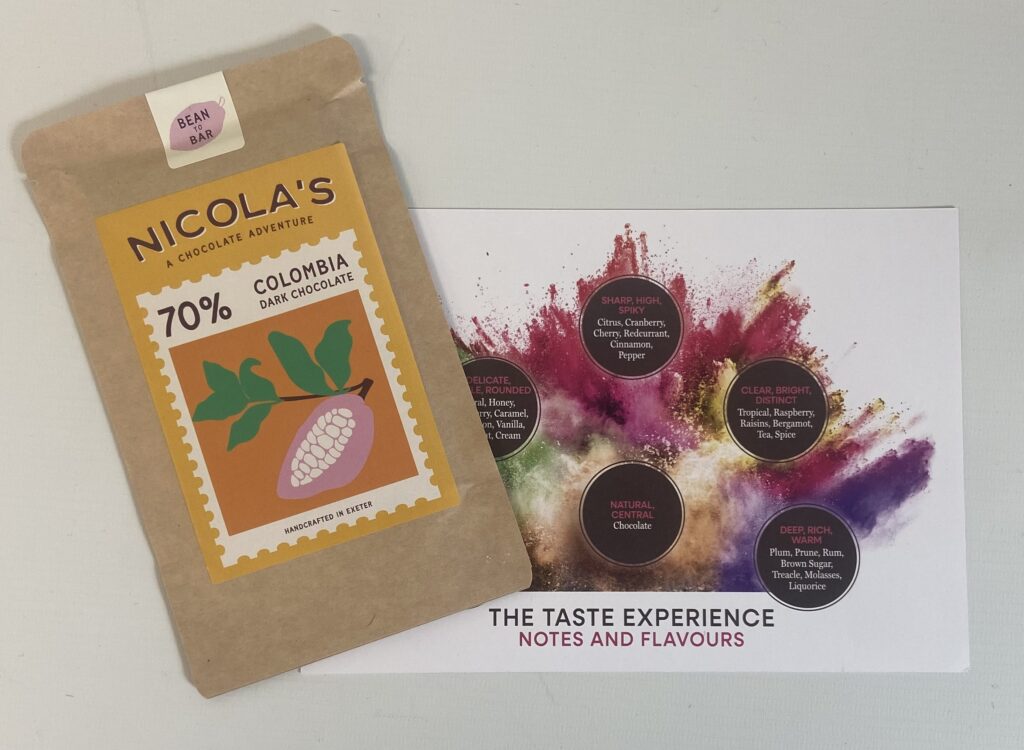
Nicola’s bar promises notes of caramelised banana, ripe orange, cocoa, and toasted nuts.
The aroma is inviting, deep chocolate with nutty undertones, hinting at what’s to come. On the palate, there’s an immediate hit of acidity—like fresh orange or even tangerine—the acidity mellows into banana and sweetens into banoffee pie. As the melt continues, the flavour shifts to toasted nuts and natural cocoa powder, before finishing with a return of that bright tang presented at the start.
This time the bar isn't just smooth, bitter, sweet and familiar, it delivers on flavour. It might be unfamiliar to someone used to mass-market chocolate, but to anyone curious about flavour or us bean geeks, it’s a lively, layered, and expressive experience.
The contrasting levels of transparency and craftsmanship between these two Colombian dark chocolate bars are ultimately confirmed by their taste.
The Cox & Co 71% Colombia is a plain bar positioned to appeal to conscious consumers, yet it remains part of a larger, more industrialised supply chain—albeit a traceable one, and better than many. The real issue here is the use of the phrase “farm to bar cacao”, which misleadingly suggests full transparency and control from origin to finished product. This bar's farm to bar story tells us more about marketing than transparency and flavour: fashionable rather than fine.
The Nicola’s Chocolate 70% Colombia on the other hand, is fine chocolate. Every stage from sourcing, to roasting and wrapping, is visible, intentional, and led by the maker herself. The taste reflects the beans, the people who grew them, and the skill that shaped them. It is complex, and the process behind it is bean-to-bar, small-scale, and honest.
So, is farm to bar better than bean to bar?
As I said at the start: it depends. Ultimately, transparency, craftsmanship, and taste are the best guides. Let them help you make up your own mind and find what you are really looking for in your chocolate.
Curious to learn how to identify genuinely fine and crafted chocolate? Explore my micro-learning course: An Appreciation of Fine Chocolate.
Afromuvaras Association, 2025. Mas Que Una Historia - Instagram. [Online]
Available at: https://www.instagram.com/afromuvaras_/?hl=en
[Accessed 1 August 2025].
Belco, n.d. Cacao de Mujeres. [Online]
Available at: https://www.belco.fr/cacaos/993000300100000/cacao-de-mujeres
[Accessed 1 August 2025].
Companies House, 2025. Fine and Update Company Information Service. [Online]
Available at: https://find-and-update.company-information.service.gov.uk/company/10859391/officers
Confection Affection, n.d. Cox & Co 100 dark Colombian Chocolate Bar. [Online]
Available at: https://www.confectionaffection.net/cox--co-100-dark-columbian-chocolate-bar-14366-p.asp
[Accessed 1 August 2025].
Cox & Co, n.d. Our Story. [Online]
Available at: https://coxandcocacao.com/pages/our-story
[Accessed 30 July 2025].
Journalist, T. C., 2017. Sustainability Colombian Fine Cacao. [Online]
Available at: https://www.thechocolatejournalist.com/blog/sustainability-colombian-fine-cacao
[Accessed 30 July 2025].
Luker Chocolate, 2024. The Chocolate Dream Progress Report 2024, s.l.: s.n.
Luker Chocolate, 2025. The Chocolate Dream. [Online]
Available at: https://lukerchocolate.com/en/sourcing-sustainability/the-chocolate-dream
Luker Chocolate, n.d. Sustainable Chocolate. [Online]
Available at: https://lukerchocolate.com/en/sustainable-chocolate
[Accessed 30 July 2025].
Myers, A., 2025. luker-chocolate-and-the-case-for-cocoa-trust. [Online]
Available at: https://cocoaradar.com/luker-chocolate-and-the-case-for-cocoa-trust/
[Accessed 1 August 2025].
Nicolas Chocolate, 2025. About Us. [Online]
Available at: https://www.nicolaschocolate.com/about-us
Nicola's Chocolate, 2025. About Us. [Online]
Available at: https://www.nicolaschocolate.com/about-us
[Accessed 1 August 2025].
THE DD Team, n.d. Our Story. [Online]
Available at: https://daniels-delight.myshopify.com/
[Accessed 30 July 2025].
The recent craft chocolate takeover at Canopy Market provided the perfect venue for the launch of the Cocoa Runners Craft Chocolate Book Club. For this collaboration with Cocoa Runners I am very excited to have teamed up with artist, writer and chocolate expert Cat Black to produce what will be a dream for lovers of literature and fine chocolate.
Though a series of recorded tastings and conversations, we will be presenting the joys and intrigue of a good read along with the sensory experience and fascinating stories behind some of the world’s finest chocolate.
Both book clubs and individuals can taste along with our recording and the Craft Chocolate Book Club box sets will be available to buy through Cocoa Runners.
The first pairing of the series explores the themes of repression and expression in life and chocolate.
The book chosen to launch the initiative is Matt Cain’s captivating and heart-warming latest novel, ‘The Secret Life of Albert Entwistle’.

Through a tasting of white and dark chocolate bars made with cocoa beans from countries where homosexuality is either illegal or a social taboo, or crafted to perfection with some unconventional flavour combinations, this first pairing of the series explores the themes of repression and expression in both life and chocolate.
It was a shared passion for literature and fine chocolate that brought me and Cat Black together.
...tasting, is a universal shared experience. It is a primary experience, deeply instinctive and involving all our senses. Somehow, placing this alongside a text, can allow us to wake up to certain thoughts and ideas.

“My primary purpose for doing this is a great desire to share wonderful books and fine chocolate” says Cat.
“Reading is one of my most precious life experiences. It starts in the head, in our thoughts, but it needs not to be a passive thing. We know that books can hold up a mirror and teach us things about ourselves, and they can also open doors and teach us about other people, other lived experiences. Eating, tasting, is a universal shared experience. It is a primary experience, deeply instinctive and involving all our senses. Somehow, placing this alongside a text, can allow us to wake up to certain thoughts and ideas. If nothing else it serves as a prompt, a conversation starter. And as far as I am concerned anything that gets us deepening our experience of reading, or tasting, is a good idea”.
The passion that Cat and Kathryn have for this concept is intoxicating.
Nick Saxby, from Cocoa Runners, explained why they are excited about this new endeavour: “The passion that Cat and Kathryn have for this concept is intoxicating. We are thrilled to be able to facilitate people’s discovery of this amazing relationship between craft chocolate and the written word”.
Cocoa Runners is a leading retailer, distributor, and platform for craft chocolate in the UK. Their role in the Craft Chocolate Book Clubs will be to host the video content; where Cat and Kathryn will share their thoughts, feelings and ideas about the pairings; and also deliver the logistics for club members to receive their chocolate.
“Our mission is to make sure that the amazing work of craft chocolate makers reaches the widest audience possible. Craft chocolate not only tastes better, but it’s better for farmers and the planet too. So we are always looking for opportunities to get this positive message to more people, and give them a positive experience along the way”.
For anyone curious who wishes to join the Craft Chocolate Book Club, they can sign up on the Cocoa Runners website.
https://cocoarunners.com/craft-chocolate-book-club/
The book choice for the December gathering of Louth Literary Coven was, for all intents and purposes, a random one. The hectic lead up to Christmas, even in a pandemic, demanded a quick read. A cursory glance at the googled results for ‘short novels’ revealed the image of a still life of an egg by James Gillick, who we all know, on the cover of a Julian Barnes novel none of us had read. Random but effective.
(No spoilers)
The Sense of an Ending follows Tony Webster, a middle-aged man who, through a series of unnerving discoveries, begins to question his memory and understanding of events that happened in his youth. He realises that “remembering isn’t always the same as what you have witnessed”. Letters, emails, meetings, memories of conversations, and relationships give Tony an “unsettling sense of the limits of self-knowledge”.
Tony’s re-evaluation of his memories provided the inspiration for my craft chocolate pairings. Taste and memory are intrinsically linked, and chocolate is something we all remember from our childhood and student years.
These smells are processed by our brains in an area that is very close to the amygdala, which processes emotional memories
Scientists tell us that the majority of what we consider as flavour is perceived through our sense of smell (or olfaction). This can account for up to 90% of our taste of food. In chocolate tasting, this refers to aromas we detect by smelling the chocolate, as well as the flavonoids detected by our olfactory system as the chocolate melts and we breathe out through our nose. These smells are processed by our brains in an area that is very close to the amygdala, which processes emotional memories. The processing of smell is also different to other senses. Smells enter our brains without us consciously processing them, so even though we are very good at remembering smells, this may be why we have more difficulty in identifying and naming them. When it comes to describing them, we tend to go for the amygdala reaction: we either do or don’t like them.

It was no surprise then that when I asked everyone to tell me about their favourite chocolate from their student days, the nostalgic session revealed many memories. Not only of sweetness, texture and creamy chocolate, and the taste of flavourings and inclusions, but also of comfort, indulgence, special occasions, Christmas, gifts from Grandad, and the joy of receiving a free bar after sending off empty Wispa wrappers foraged for in hedges and rubbish bins!
I wanted the chocolate pairings to be our ‘grown-up’ chocolate choices,
In the novel, Tony looks back at his teens and early twenties and considers how the pretentiousness of youth had matured into what he sees as the stability and prudence of later life. I wanted the chocolate pairings to be our ‘grown-up’ chocolate choices, those more focused on flavour, ethics and unpredictability, but I still wanted them to trigger those emotional responses from the amygdala too. I followed each tasting of our ‘grown-up’ bars with a teenage bar that inspired its selection.

A vegan friendly honeycombe cluster made with Madagascar 67% chocolate couverture and Agave Nectar was inspired by our memories of the Cadbury Crunchie. We experienced a pleasurable melt and that familiar sweetness balanced with the thick covering of dark chocolate. The quality of the couverture let the experience down for me, but I was a lone voice. The general emotional response was simply, “I love that!” The crunch of the Crunchie bar was just as we remembered. It was super-sweet and stuck to our teeth yet some still enjoyed it.

this really hit the spot – flavour and ethics in abundance but oozing with comfort, indulgence and pleasure too.
Inspired by our favourite caramel combos, particularly the Cadbury Curly Wurly, I chose Solkiki’s vegan, Peruvian chocolate made with organic coconut, a touch of pink mountain salt, and a long conche to release the beautiful caramel flavours. This bar showcased sweet caramel in a very cultivated form, with the visually appealing Curly Wurly’s ladder shape replaced by the gorgeous Solkiki mould. Wow, this really hit the spot – flavour and ethics in abundance but oozing with comfort, indulgence and pleasure too. Sadly, the Curly Wurly didn’t fare so well. Everything but its shape failed to recall any feelings of pleasure, present or past.

The vividly zesty orange in the dark fruity chocolate immediately transported us back to our childhood Christmases.
The iconic Terry’s Chocolate Orange and its taste and memories of Christmas led me to Duffy’s Chocolate Orange bar. The vividly zesty orange in the dark fruity chocolate immediately transported us back to our childhood Christmases. It was “absolutely lovely” and raised our spirits much more effectively than the subsequent tasting of the once treasured, boxed and foiled chocolate orange, the smell, taste and emotions of which were all disappointing. But one of us persevered until that memory of Christmas returned.

I chose a dark, vegan milk made with Nacional beans to deliver that straightforward milk chocolate experience of comfort in a bar. It started well with a sweet chocolate aroma. This time, comfort wasn’t delivered in the form of a super smooth hit of creamy sweetness, but with a mouth-wateringly good taste experience. A deep caramelly and chocolate flavour, with a bright, juicy acidity, and an aftertaste that just went on and on. It was liked by all. For me, it is a straight swap for my good memories of milk chocolate, but at 64% it was a little too far away from the classic milk chocolate experience, making it more reminiscent of a good dark bar. But then, the Dairy Milk Buttons didn’t perform particularly well either. Although still comforting for some, the aroma, taste and mouthfeel were unrecognisable. For others they were unpalatable.

my suggestion for the ultimate ‘grown-up’ crumbliest milk chocolate
Soma’s Milk Old School, already a firm favourite of the group, was brought back to compare with the textured treats of a Flake, Wispa, Twirl or Aero. Soma’s divine combination of crumble, melt and central chocolate flavours was just as we remembered from previous tastings. Just amazing. Texture, however, was not considered a treat by the whole group, leaving some a little unimpressed with my suggestion for the ultimate ‘grown-up’ crumbliest milk chocolate. The rest of us The rest of us dismissed them, of course! Like Tony Webster, they just didn’t get it. The Wispa, I confess, did do a little better than the Buttons, helped of course by the addition of 4% cocoa mass and air!
Our memories of chocolate were full of emotional connections. Tasting the bars of our youth in our middle age may not have delivered the taste experience we remembered, but we are still the same people as we had been at school. Our taste buds may have matured along with the recipes of the bars but the emotions are still there.
https://www.gillick-artist.com/gallery/Still+Life-7/
http://www.duffyschocolate.co.uk/
https://www.somachocolate.com/products/old-school-milk-chuao-bar
Barnes, J., 2012. The Sense of an Ending. Reprint ed. New York: Vintage Books.
Fields, H., 2012. Fragrant Flashbacks. [Online]
Available at: https://www.psychologicalscience.org/observer/fragrant-flashbacks
[Accessed 8 Dec 2020].
Jordan, J., 2011. The Sense of an Ending by Julian Barnes – review. [Online]
Available at: https://www.theguardian.com/books/2011/jul/26/sense-ending-julian-barnes-review1
[Accessed 30 Dec 2020].
Spence, C., 2015. Multisensory flavor perception.. [Online]
Available at: https://pubmed.ncbi.nlm.nih.gov/25815982/
[Accessed 8 Dec 2020].
Stuckey, B., 2012. Taste What You're Missing: The Passionate Eater's Guide to Why Food Tastes Good. New York: Free Press.
For the March gathering of the Louth Literary Coven (before the lockdown!) we received a recommendation from writer and international chocolate judge Cat Black, who suggested we read Andrew Miller’s Now We Shall Be Entirely Free. This historical thriller, set at the height of the Napoleonic Wars presented me with the challenge of finding craft chocolate to enlighten us about the historical context and, at the same time, make an assault on our senses. Who better to ask for ideas than Cat Black herself. “Definitely something with salt” was among the brilliant suggestions. It soon became apparent why…
I think it is fair to say that the Napoleonic Wars is a historical period that none of us were particularly familiar with. Those of us who studied Spanish remembered the haunting scenes of the uprisings in Goya’s Dos De Mayo and the ensuing executions depicted in his Tres De Mayo. That, however, was over 35 years. No matter, as Miller brings history to life through its wider context, creating a sensory experience and familiarity that helps us feel both the cruelty and the human kindness of the time.
The origins of the chosen chocolate took us on a journey to the cocoa-growing Spanish colonies of Ecuador, Peru and the Dominican Republic. In 1808, the imposition of Joseph Bonaparte by Napoleon on the Spanish throne sent shock waves through the colonies. While Lacroix was being pursued through the Hebrides by Calley and Medina, the plantation owners of Spanish America were planning their own revolutions. As with the islanders in the novel, with the exception of a little more cruelty and bloodshed no doubt, life was less disrupted for the slaves or former slaves labouring away in the cacao plantations. In São Tomé, another colonial battleground, then held by Portugal, it would be another fifteen years or so before the plantation workers would be forced to grow cacao as well as sugarcane to feed the habits of their European colonisers.
"Everything tasted of salt" and the senses are used as a literary device throughout: Lacroix is half deaf, Emily is going blind, Ranald has hooks for hands and the laudanum, whisky and brandy dull their perception of real life. Senses are dulled but then stimulated with music, romance, walking with no boots, needles in eyes, salt, smoke and the cold that hurts your hands even though they are no longer there!
Through my chocolate choices, I wanted us to taste the elemental character of the chocolate, while our senses were being thrilled with the additions of salt, smoke, alcohol and nibs.
This bar was a must, given the habitual presence of sea salt and smoke throughout the novel.
We enjoyed the caramel notes of the aroma but were split over the rest of the experience. Some of us loved the sweet and salty contrast, the subtle but discernible smokiness of the salt crystals, the gradual strengthening of the salt along the tasting journey pushing the sweet caramel flavours into the background and the sensorial coup de grâce of the remaining nibs. For some, a lovely sweet, salty, crunchy chocolate experience, with a lingering aftertaste, but for others, the dominance of the salt and nibs was just too much of an attack on the senses.
We moved on to the potential deep caramel and liquorice notes of the Peruvian dark milk with the addition of the ‘purest’ type of salt: pink salt crystals, rich in essential nutrients, mined from the Himalayan mountains of Pakistan. Nibs again, but this time soaked in Ararat Brandy.
We picked up a heady mix of aromas: chocolate, a little fruit, honey, vanilla and sweet alcohol. The sweet brandy of the nibs hit us first, swiftly followed by the contrasting creamy, caramelly chocolate. The salt evaded us this time, acting simply to increase the sweetness of the chocolate: the brandy-soaked nibs providing the opposition to the sweetness rather than the salt.
One of our group thought that this bar was the best match for the book. “It had a bit of everything”, she said, “salty, boozy and the texture of the nibs was a bit uncomfortable to eat and John (Lacroix) does spend a lot of the book in discomfort!”.... my choice justified!
The novel is played out mainly in Glasgow and the Hebrides but Lacroix’s memories of his time as a red coat also take us to Portugal: an opportunity to taste another bar from Portuguese makers Feitoria do Cacao. Their salted bar is made with cacao from São Tomé and uses the delicate taste of Flor de Sal harvested by hand from tidal beds of Aveiro.
The aroma was initially a little reluctant to deliver its subtle flavours, but the chocolatey notes gradually revealed a little citrus and dried fruits. A fairly quick melt initially delivered a slight bitterness which was quickly subdued by the salt. The initial taste of the salt allowed sweeter, fresher red fruit notes to reveal themselves from between the deep bold chocolate notes, then a return to the salt at the end.
The fruit notes were quite different from the deep prune notes picked up in the aroma, the effect of the salt perhaps: the presence of salt increases our perception of sweetness and helps release aroma molecules.
A more duotone profile, but an accomplished interpretation of São Tomé cacao and a superb demonstration of how salt can influence our perception and play with the intrinsic flavours of the cacao.
Onward to Glasgow!
When searching for Scottish makers, I came across a new maker from Glasgow called Bare Bones. Even the name was perfect, taking me straight back to Ranald feeling the cold in his bones, Calley’s bizarre recollection of a girl working at the mill having her arm ripped off at the shoulder, and more generally the feeling of being exposed to the elements.
All thoughts of carnage were cast away as we took in the beautiful aroma of the Bare Bones bar: chocolate, hazelnut, caramel and treacle. We all enjoyed the easy, even melt after the conflicting textures of the first two bars. The mouthfeel was full-bodied and deeply satisfying. The initial salt hit gave way to a delivery of real fruitiness, quite different from the nutty aroma. We were tasting sweet fruits: strawberry, even a hint of pineapple; “plummy” and “treacly” were mentioned too. Then the aftertaste reverted back to the aroma notes with the gorgeousness of a caramel and chocolate spread finish. A truly scrumptious, mouth-watering chocolate!
Like everything that evening, this bar tasted of salt but the experience was more of a tender caress than a sensorial onslaught.
The Bare Bones bar was generally considered the best match for the book. It was from Glasgow for starters! It was dark and complex, the salt was there but not overpowering and left us feeling uplifted. It was the music and dancing of the novel rather than the conflict and discomfort, but the drama offered by both the book and the chocolate was appreciated by all.
This blog post is a summary of my post on the Louth Literary Coven's Mainly Books and Chocolate blog. The complete post gives all our thoughts on the book’s themes and messages, as well as our full chocolate tasting descriptions and votes for our favourite bars. You can link to the full blog post here.

For Louth Literary Coven’s November gathering, we chose an illuminating combination of literature and craft chocolate that delved deep into the secrets of a Lincolnshire family and the ancestry of fine cacao.
The obvious choice for craft chocolate paired with memories of Chapel St Leonards on the Lincolnshire coast was Duffy's Chocolate, based just a little further north in Cleethorpes.
Tempting as it was to do a full line up of Duffy's Chocolate, the book's pursuit of truth took us right across the globe, so I felt the chocolate choice should follow suit.
On Chapel Sands opens with the traumatic abduction of a small child on a Lincolnshire beach, an event that is forgotten surprisingly quickly as you are drawn into the pictures, recollections and mysteries of Beth's childhood. As the book progresses, the discoveries that seemingly shed light on the behaviour of Beth's parents only pose more questions about their actions and relationships.
As we all live very close to Chapel St Leonards, with most of us having grown up in Lincolnshire, we were fascinated by the references to local history and familiar places. We also loved the use of artists and their work to help decode and interpret the everyday lives of the Lincolnshire villagers.
My chocolate choices were inspired by the book’s theme of nature versus nurture. This gave us the opportunity to look at how a bar's character is influenced by both the inherited, genetic profile of the cacao, and the post-harvest and making processes.
The terms Criollo, Forastero or Trinitario seen on craft chocolate bars relate, in very general terms, to the variety of cacao beans used to make them and give clues to their ancestry and potential taste profile. I chose the following bars initially for their variety, but their origin and maker also have significance as you will see:
(N.B. Spoilers present in the discussion of chocolate pairings)
The first craft chocolate pairing combined a bar made with the 'mother' of cacao (Criollo beans from Guasare) and Beth’s birth mother Hilda.
The strong, enticing aroma, beautifully smooth texture and the initial bold cocoa and coffee notes evolved into a much gentler and more sophisticated experience. We deliberated over the identity of the jam and fruit notes. The talk of jam reminded us of the heart-warming tart-making scene in Hilda’s family bakery during the first part of Beth’s story; her only memory of those early years was the smell of warm strawberry jam.
The chocolate was complex and beautifully balanced, but these characteristics challenged our knowledge of Hilda and the decisions she had taken; we realised we didn’t have sufficient evidence to judge her as a person or as a mother.
Our next match was a Forestero bar, the second parent variety with Beth’s father George. The strong but flat chocolate profile was a stark contrast to the nuanced flavours and complexity of the Criollo beans of the previous bar. A contrast that made the coming together of George and Hilda equally poignant. Such a strange combination! This bar greeted us with a robust aroma of roasted nuts and molasses. A smooth, slow and balanced melt revealed deep roasted flavours, the hints of acidity being overpowered by the treacly and dark sugar notes.
We pondered over what we knew about George: was he strong and bitter or just frustrated and simply resigned to his fate? If he had been born in a different time with the option of divorce and a chance to cultivate his more creative abilities would George have been a different person or would his apparent lack of emotion and suppressive nature still dominate his character?
We turned then to the Trinitario varieties, the descendants or hybrids created by the coupling of the Criollo and Forastero. This hybridisation of cacao has continued ever since that first union, making the genetic pool rich and complex. Veda, Beth's adoptive mother, brings a new personality into the mix and Beth's parentage is not, as we discover, straightforward. I therefore chose Trinitarios for both Veda and Beth, selecting bars from the same maker and region to create the environmental link between them.
Our ‘Veda’ is a Dominican Republic bar presenting us with a smoky aroma, with hints of sweet fruit. This felt really sweet after the previous bar: honey sweet, muscovado sweet, pineapple sweet. Too sweet for Veda. It had character but less pronounced than both the Criollo and Forastero bars and without a hint of bitterness. This comparatively more reserved profile was a more successful match for Veda.
The final craft chocolate pairing brought together our protagonist Beth with Duffy's new Dominica bar made with beans of uncertain parentage which I presumed to be Trinitario.
We debated whether we could detect any traces of the Criollo and Forastero ancestry, or if it had more in common with the Trinitario from the not too far away island of Hispaniola. The aroma was certainly more in line with Duffy's Dominican Republic bar: mild but distinctive with red fruit notes, and the sweetness was there too.
Our silent appreciation, along with the complex taste experience suggested Criollo origins. Not a whisper of the bold, overbearing Forastero bar though. We think this would have pleased Beth considering her feelings towards her father.
Overall, we felt the style and flavour delivery of the Dominica bar had more in common with the Dominican Republic bar. Just as Veda's presence had helped shape Beth's personality, the maker Duffy has teased out and developed the distinct, intrinsic flavours of the Dominican Republic and Dominican beans giving them shared personality traits over and above the genetic profile of the cacao.
We had tasted some fascinating craft chocolate from Soma, Pralus and Duffy's Chocolate, showcasing some superb breeding and craftsmanship. They encouraged us to examine and share our thoughts on the conduct and character of Beth's family members and the mysteries that remain unsolved. Another deliciously informative evening at Louth Literary Coven!
This blog post is a summary of my post on the Mainly Books and Chocolate blog. The complete post gives all our thoughts on the book’s themes and messages, as well as our full chocolate tasting descriptions and votes for our favourite bars. You can link to the full blog post here.
Sources:
Cumming, Laura (2019). On chapel sands: My mother and other missing persons. London: Chatto & Windus.
The book and themes:
https://www.theguardian.com/books/2019/jun/26/on-chapel-sands-laura-cumming-review
On Chapel Sands by Laura Cumming review – twists right to the end
https://www.standard.co.uk/lifestyle/books/review-on-chapel-sands-by-laura-cumming-a4177196.html
Duffy's Chocolate. Available at http://www.duffyschocolate.co.uk/shop/chocolate-bars/duffys-dominican-republic-taino-65-60g (Accessed 8/11/19)
Soma Chocolate, Available at https://www.somachocolate.com/collections/microbatch-2019/products/guasare-venezuela-70?variant=13528243896372 (Accessed 8/11/19)
Presilla, M.E (2009), The New Taste of Chocolate, Revised: A Cultural & Natural History of Cacao with Recipes [A Cookbook]
Frizo, C (2018) 'Is Criollo Really King? The Myth of Cacao's three varieties', Perfect Daily Grind, 27 August. Available at https://www.perfectdailygrind.com/2018/08/is-criollo-chocolate-really-king-the-myth-of-the-3-cacao-varieties/ (Accessed 12/12/2019)
'Chocolate Strains', C-Spot.com. Available at https://www.c-spot.com/atlas/chocolate-strains/ (Accessed 12/12/2019)
Cocoa Runners, 'Cocoa Varieties', Available at https://cocoarunners.com/chocopedia-by-cocoa-runners/the-science-history-of-chocolate/the-history-of-craft-chocolate/ (Accessed 11/12/19)
Division of Agriculture, Government of the Commonwealth of Dominica, 'Cocoa and Coffee Project' Available at https://divisionofagriculture.gov.dm/programmes/cocoa-and-coffee-project (Accessed 30/12/19)
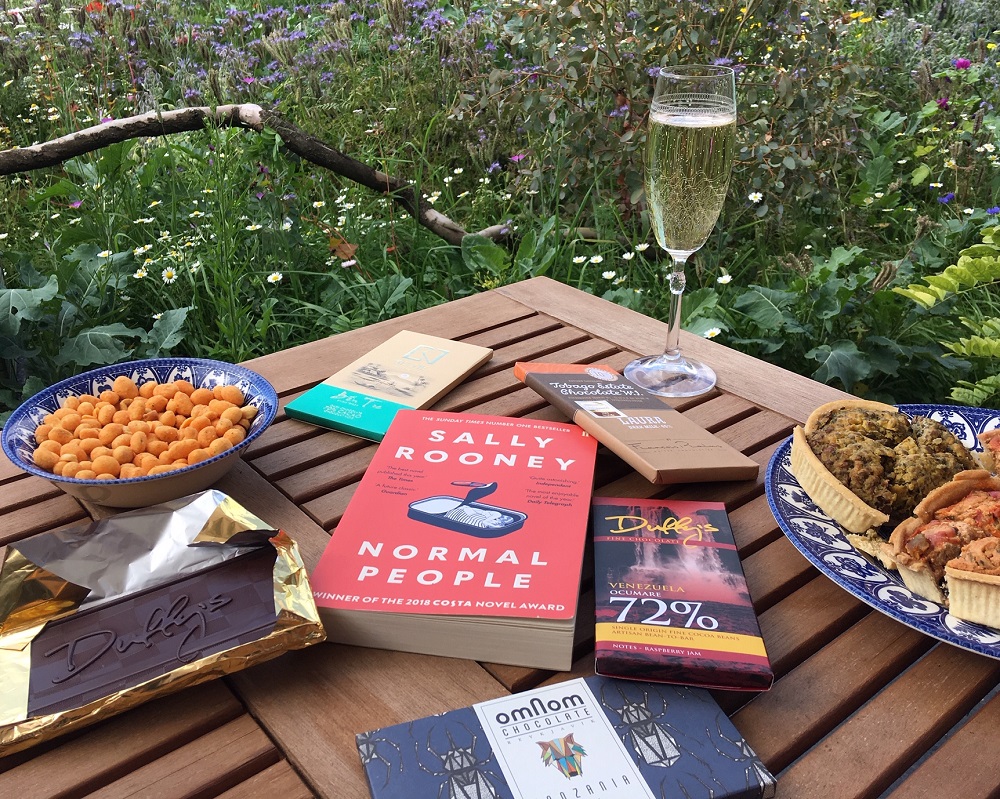
The Louth Literary Coven book club members met for their late summer craft chocolate and book pairing recently. To stimulate discussion and hopefully add to the overall enjoyment of the afternoon, I chose four bars to bring attention to the underlying themes of the novel.
On the basis that Rooney's Normal People encourages us to consider how her main characters, Marianne and Connell, are endeavouring to work towards a more equal relationship, where money and social capital are shared, I decided to do the same with my craft chocolate choices.
Our book discussion focused predominantly on the appeal and development of the characters and the intensity and frustration of their will-they-won't-they relationship. It was a great story and so well written. It was effortless, intense and a pleasure to read.
After our initial discussion we tasted the craft chocolate with bars selected to represent different models of fairer trade, and illustrate how craft chocolate makers are not just focusing on delivering a fine-flavour taste experience, but also on creating more equal trading relationships. These are the bars we tasted along with a brief overview of the group’s thoughts:
Our first book club craft chocolate pairing was the award-winning ‘Laura’ from the island of Tobago. A delicious bar with thick oozy caramel notes running into higher, sweeter honey notes and a Cadbury Eclair finish. A deliciously comforting bar made by Tobago based Duane Dove whose mission is to make chocolate with the best raw materials, completely free from exploited labour. Rather than selling beans to a European maker, Duane has the chocolate made for him by French experts, Pralus. A transparent and we presume, an equal partnership between grower and maker.
Next in our book club chocolate pairings was Belvie’s Ben Tre Vietnam. Originating from a Caribbean hillside plantation, where the cacao farmers work among the rice fields and water buffalo of Vietnam. A complex bar with flavours swinging gently between sweet and sour notes, made from beans purchased directly from the farmer and made from bean to bar in Vietnam. A better price for the farmers and the profits remaining in the country of origin
Continuing the book club pairings, we moved on to the chocolate of the Kokoa Kamili Cooperative farmers in the Kilombero Valley, on the edge of Tanzania’s Udzungwa Mountain National Park. This time made by Icelandic makers Omnom. A heavenly taste experience delivering peaks of fruitiness: lemon sherbet, yellow fruits, plums and sweet figs balanced with a luscious, chocolate brownie baseline. Purchasing beans from this community of growers brings real economic development to rural Tanzanian farmers.
The final of our book club chocolate pairings was Duffy's Venezuela Ocumare. This bar took us right back to the beginning of the story of Europe’s love affair with chocolate, and the growing of cacao being a contentious, political and often violent issue. The chocolate was full of character: sweet, sumptuous and enigmatic. Varying market structures and political pressures in the country of origin can create problems for direct trade. This is certainly the case with Venezuela.
The maker Duffy Sheardown is involved in the ‘Direct Cacao’ initiative. An association based on ‘respect, value and mutual benefit between cacao growers, chocolate makers and consumers, aiming to protect and preserve fine cacao’. But buying cacao is difficult in Venezuela as Duffy explained to me, “We cannot buy direct from Venezuela and have to use a wholesaler that we trust and that has a good reputation. We hope to go Direct Trade there at some point.”
Just like the book, the tasting had been an effortless, intense experience and the chocolate a pleasure to eat. The research on the makers and their trading relationships, however, made us look beyond the great taste experience and consider the politics of power and dependency and also encouraged the group to look again at our reading of Normal People and the possibility that this too was about power, not just love but a "Marxism of the heart". (Annalisa Quinn, www.theatlantic.com, April 19)
Through our book club chocolate pairings, we saw how Rooney had embedded politics 'closely and rigorously' (Annalisa Quinn) into her love story and how craft chocolate isn’t just about taste but how makers are also striving to move towards more equal trading relationships.
The result: a fabulous late summer gathering!
For our thoughts on the book’s themes and messages, as well as our full chocolate tasting descriptions and votes for our favourite bars, read the Louth Literary Coven’s full post on the Mainly Books and Chocolate blog here.
Further reading
For further reading on Normal People, the chocolate makers and the trade relationships in craft chocolate, these are some suggested links:
Review of Normal People by Annalisa Quinn https://www.theatlantic.com/entertainment/archive/2019/04/sally-rooneys-normal-people-review/586801/
Tobago Estate Chocolate https://www.tobagococoa.com/
Belvie, Belgium’s First Short-Chain Chocolate Made In Vietnam: “Fair Trade Is Marketing” http://www.belviechocolate.com/2017/02/11/belvie-belgiums-first-short-chain-chocolate-made-vietnam-fair-trade-marketing/
Omnom Chocolate: https://www.omnomchocolate.com/pages/our-ingredients
Kokoa Kamili: http://www.kokoakamili.com/about
Duffy's Chocolate: http://www.duffyschocolate.co.uk/
Direct Cacao Initiative: https://www.directcacao.org/
The Chocolate Journalist on Fair Trade: https://thechocolatejournalist.com/fair-trade-chocolate-debunking-the-myth/
Goodnow Farms on Fair Trade: https://goodnowfarms.com/blog/fair-trade-vs-direct-trade/


