Too hot to taste chocolate? Sit back and take the Appreciation of Fine Chocolate on-demand video course, a fascinating guide to the world of fine chocolate.
Sometimes at Louth Literary Coven someone chooses a book that captivates and unsettles us all, without exception. This was one such book. Some home truths about the history and ethics behind our beloved chocolate left our consciences similarly ruffled.

Small Things Like These is an exquisitely written short novel by Claire Keegan that explores the crisis of conscience experienced by Bill Furlong, coal merchant, husband and father of five, when he witnesses the cruelty taking place at the nearby Magdalene laundry.
The turbulence of Bill Furlong’s inner life is set against the domestic rituals and traditions involved in the lead up to a family Christmas. The happiness and stability conveyed is almost Dickensian, but despite Bill’s years of hard work, and good “Protestant habits”, this familial security feels fragile. The tension created by the tyranny being played out at the nearby convent, and the town’s complicity by keeping silent, plays on Bill’s mind until he must decide whether to act or to maintain the order of things.
The allusions to Dickens make the realisation that this story unfolds in the 1980s all the more shocking. As does the context of the real Magdalene laundries where an estimated 30,000 women were confined, where numerous unmarked graves were discovered, and the last institution didn’t close its doors until 1996. Set up with the aim of saving the souls of women and children unfortunate enough to find themselves there, these laundries allowed their congregations to build up millions of pounds in assets to fund their work. The Church being, in part, funded by the labour of these “fallen women”. (Mary Regan, 2013)
Bill Furlong’s character was tender, empathic, complex and funny, but given his split loyalties we reflected whether, as wives and mothers, we would have supported his decisions.
In 2013, after revelations about the treatment of women in the Magdalene laundries, the Irish Government issued a formal apology and pledged 58 million Euros in compensation to survivors. (Reuters, 2013) An apology for the Catholic crimes against the indigenous peoples during the colonisation of the Americas was a little later to arrive. Pope Francis issued the historic apology on his first papal visit to Latin America in 2015. (Boren, 2015)
During the conquest of the Americas indigenous souls were as keenly sought as venerated cacao, and my pairings were inspired by the history of cacao and parallels in the involvement of the church in the use of captive labour in the name of religious endeavour. The Jesuits, in particular, were among the first to recognise the value of the high-quality variety of cocoa initially grown in Mexico, and then western Venezuela, and used the proceeds of its cultivation to contribute to the financing of their schools and missions. (Harwich, 2020)
Our first two bars give us an insight into the quality of the cacao that seduced the Jesuit missionaries.
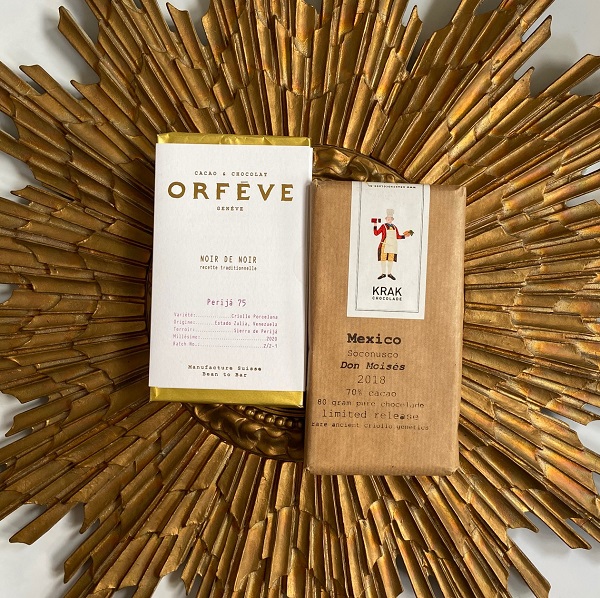
Our chocolate from Mexico comes from a small-scale plantation, Finca La Rioja, established in the early 1900s by another Spanish immigrant, Moises Muguerza Gutierrez (Don Moises), and now run by his great-grandson, who can be proud of the distinction and old-world ancestry of the cacao he has inherited.
The pale milk chocolate hue was a good clue to its character: central cream and hazelnut flavours, a gentle flavour delivery with hints of bonfire toffee, citrus and liquorice to add intrigue and complexity and to keep us captivated.
Our taste of Venezuela came from Swiss makers Orfeve and is made with the revered Porcelana from the Zulia Estate in the Sierra de Perija by the river Guasare. This beautifully smooth, pale coloured chocolate revealed high raspberry notes, rounded hazelnuts, earthy reverberations and dancing roses in the aftertaste.
Pleasurable and comforting, the way chocolate should be, and enjoyed all the more in the knowledge that any tyranny involved in its production is now at a safe historical distance.
Our tasting of both bars gave us some insight into the allure of this beautiful substance. Pleasurable and comforting, the way chocolate should be, and enjoyed all the more in the knowledge that any tyranny involved in its production is now at a safe historical distance.
As the demand for cacao grew among the colonies and back at home, the production of cacao stepped up a notch in Brazil, along with the saving of souls in the Jesuit run reducciones or missions. The forced conversion of the indigenous population and the creation of efficient farming estates arguably saved many souls from the slave traders, but how free they really were we can only speculate. Our next two bars are made with cacao from Brazil.
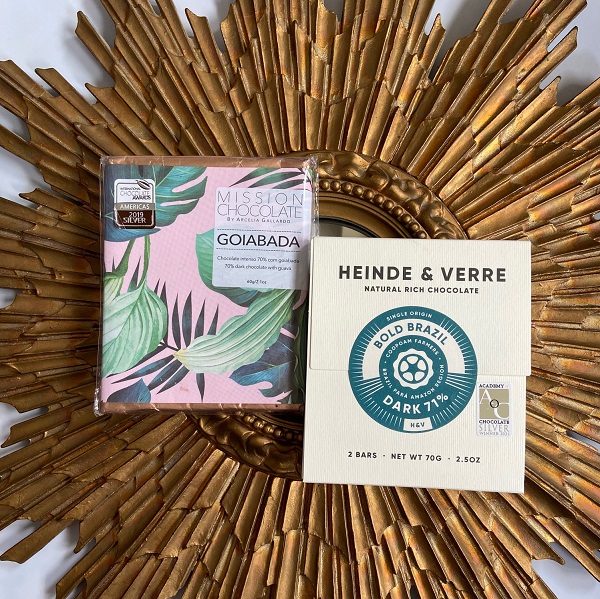
The cacao for this bar is sourced from a central cooperative in the state of Pará in Northern Brazil, and has multiple roasting profiles applied to it to increase the boldness of character.
We found a spicy aroma that carried through to the initial flavour. We tasted tomato sauce, chilli and lemon with a touch of Turkish delight on the finish. Straightforward and most certainly bold.
The aptly named Mission chocolate was founded by Arcelia Gallardo who crafts chocolate in Sao Paulo, Brazil. This bar is an award-winning combination of bold earthy cacao from Bahia and chunks of sweet crystalised guava. I absolutely love the taste of guava. This should have been a marriage made in heaven, but the palates of my book club friends struggled to find the harmony. It looked divine and sounded delicious, but our tasting recalled the dynamics between Bill and Eileen. On the surface they seemed to have everything in place, but would their relationship end in success or failure?
... there is tyranny still near, and my guess is that no-one is going to apologise for it any time soon.
Heinde & Verre means “near and far”. We had tasted bars made from cacao in places where cruelty and coercion were far enough away from our own time and experience, but for Bill and his family tyranny was in unsettling proximity: “some part of his mind was often tense, he could not say why.” This is the reason for including the Tonys Chocoloney bar in our discussions because there is tyranny still near, and my guess is that no-one is going to apologise for it any time soon.
The team at Tonys Chocoloney are calling out slave labour in the supply chain and encouraging people to take action by purchasing their chocolate instead of chocolate made by the chocolate giants (Tonys Chocoloney, 2022). Can we draw a parallel with Bill Furlong here? If Bill Furlong did act, it would mean a massive sacrifice, his whole life and that of his family would be put at risk. What risk are Tony’s Chocoloney taking through their actions? They are pointing directly at the business practices of the big brands but then at the same time working with one of the biggest companies, Barry Callebaut. So, we thought not; in fact, it was the small things we found that revealed sentiments that created an even bigger gulf between them.
We can read all about the good intentions of this brand, but there are details that surface that could make you question its true revolutionary nature, and their calculation of the Fairtrade premium reported in the Cocoa Barometer is just one. (Voice Network, 2020)
You can read about it here: https://voicenetwork.cc/wp-content/uploads/2020/01/200113-Necessary-Farm-Gate-Prices-for-a-Living-Income-Definitive.pdf
We were all keen to side with Bill but based on how easily society in general ignores the existence of the wrongful use of labour, including those of cacao farmers, we were left questioning the extent to which, when put to the test, we would be willing to sacrifice our own comfort and security to ensure the civil liberty, equal rights and equal opportunities of others.
A genuinely thought-provoking book and chocolate pairing.
https://krakchocolade.nl/en/origine/soconusco-don-moises-en/
https://heindeverre.com/chocolate/boldbrazildark/
https://www.missionchocolate.com.br/collections/chocolate-bars
Boren, Z. D. (2015, July 10). Pope Francis apologies for Cathorlic crimes against indigenous peoples during the colonisations of America. Retrieved from Independent: https://www.independent.co.uk/news/world/americas/pope-francis-apologises-for-catholic-crimes-against-indigenous-peoples-during-the-colonisation-of-the-americas-10380319.html
C-Spot. (2022, May 20). C-Spot Atlas - Chocolate Sources - Amazonia Brazil. Retrieved from C-Spot: https://www.c-spot.com/atlas/chocolate-sources/amazonia/brazil/
Harwich, N. (2020, September 28). Between America and Europe Cocoa and Chocolate Trade Routes. Retrieved from https://revista.drclas.harvard.edu/between-america-and-europe
Konrad, H. (1980). A Jesuit Hacienda in Colonial Mexico: Santa Lucia, 1576 - 1567. . Stanford, CA: Stanford University Press.
Mary Regan. (2013, FEb 27). irishexaminer.com. Retrieved from Irish Examiner: https://www.irishexaminer.com/news/arid-20223896.html
Reuters Staff. (2013, June 26). Ireland agrees compensation for Magdalene Laundries survivors. Retrieved from Reuters.com: https://www.reuters.com/article/us-ireland-laundries-compensation-idUSBRE95P18420130626
Tonys Chocoloney. (2022, August 5). Tonys Chocoloney Our Mission. Retrieved from tonyschocoloney.com: https://tonyschocolonely.com/us/en/our-mission/tonys-101
Voice Network. (2020, January). Necessary Farm Gate Prices for a Living Income. Retrieved from cocoabarometer.org: https://voicenetwork.cc/wp-content/uploads/2020/01/200113-Necessary-Farm-Gate-Prices-for-a-Living-Income-Definitive.pdf
For the March gathering of the Louth Literary Coven (before the lockdown!) we received a recommendation from writer and international chocolate judge Cat Black, who suggested we read Andrew Miller’s Now We Shall Be Entirely Free. This historical thriller, set at the height of the Napoleonic Wars presented me with the challenge of finding craft chocolate to enlighten us about the historical context and, at the same time, make an assault on our senses. Who better to ask for ideas than Cat Black herself. “Definitely something with salt” was among the brilliant suggestions. It soon became apparent why…
I think it is fair to say that the Napoleonic Wars is a historical period that none of us were particularly familiar with. Those of us who studied Spanish remembered the haunting scenes of the uprisings in Goya’s Dos De Mayo and the ensuing executions depicted in his Tres De Mayo. That, however, was over 35 years. No matter, as Miller brings history to life through its wider context, creating a sensory experience and familiarity that helps us feel both the cruelty and the human kindness of the time.
The origins of the chosen chocolate took us on a journey to the cocoa-growing Spanish colonies of Ecuador, Peru and the Dominican Republic. In 1808, the imposition of Joseph Bonaparte by Napoleon on the Spanish throne sent shock waves through the colonies. While Lacroix was being pursued through the Hebrides by Calley and Medina, the plantation owners of Spanish America were planning their own revolutions. As with the islanders in the novel, with the exception of a little more cruelty and bloodshed no doubt, life was less disrupted for the slaves or former slaves labouring away in the cacao plantations. In São Tomé, another colonial battleground, then held by Portugal, it would be another fifteen years or so before the plantation workers would be forced to grow cacao as well as sugarcane to feed the habits of their European colonisers.
"Everything tasted of salt" and the senses are used as a literary device throughout: Lacroix is half deaf, Emily is going blind, Ranald has hooks for hands and the laudanum, whisky and brandy dull their perception of real life. Senses are dulled but then stimulated with music, romance, walking with no boots, needles in eyes, salt, smoke and the cold that hurts your hands even though they are no longer there!
Through my chocolate choices, I wanted us to taste the elemental character of the chocolate, while our senses were being thrilled with the additions of salt, smoke, alcohol and nibs.
This bar was a must, given the habitual presence of sea salt and smoke throughout the novel.
We enjoyed the caramel notes of the aroma but were split over the rest of the experience. Some of us loved the sweet and salty contrast, the subtle but discernible smokiness of the salt crystals, the gradual strengthening of the salt along the tasting journey pushing the sweet caramel flavours into the background and the sensorial coup de grâce of the remaining nibs. For some, a lovely sweet, salty, crunchy chocolate experience, with a lingering aftertaste, but for others, the dominance of the salt and nibs was just too much of an attack on the senses.
We moved on to the potential deep caramel and liquorice notes of the Peruvian dark milk with the addition of the ‘purest’ type of salt: pink salt crystals, rich in essential nutrients, mined from the Himalayan mountains of Pakistan. Nibs again, but this time soaked in Ararat Brandy.
We picked up a heady mix of aromas: chocolate, a little fruit, honey, vanilla and sweet alcohol. The sweet brandy of the nibs hit us first, swiftly followed by the contrasting creamy, caramelly chocolate. The salt evaded us this time, acting simply to increase the sweetness of the chocolate: the brandy-soaked nibs providing the opposition to the sweetness rather than the salt.
One of our group thought that this bar was the best match for the book. “It had a bit of everything”, she said, “salty, boozy and the texture of the nibs was a bit uncomfortable to eat and John (Lacroix) does spend a lot of the book in discomfort!”.... my choice justified!
The novel is played out mainly in Glasgow and the Hebrides but Lacroix’s memories of his time as a red coat also take us to Portugal: an opportunity to taste another bar from Portuguese makers Feitoria do Cacao. Their salted bar is made with cacao from São Tomé and uses the delicate taste of Flor de Sal harvested by hand from tidal beds of Aveiro.
The aroma was initially a little reluctant to deliver its subtle flavours, but the chocolatey notes gradually revealed a little citrus and dried fruits. A fairly quick melt initially delivered a slight bitterness which was quickly subdued by the salt. The initial taste of the salt allowed sweeter, fresher red fruit notes to reveal themselves from between the deep bold chocolate notes, then a return to the salt at the end.
The fruit notes were quite different from the deep prune notes picked up in the aroma, the effect of the salt perhaps: the presence of salt increases our perception of sweetness and helps release aroma molecules.
A more duotone profile, but an accomplished interpretation of São Tomé cacao and a superb demonstration of how salt can influence our perception and play with the intrinsic flavours of the cacao.
Onward to Glasgow!
When searching for Scottish makers, I came across a new maker from Glasgow called Bare Bones. Even the name was perfect, taking me straight back to Ranald feeling the cold in his bones, Calley’s bizarre recollection of a girl working at the mill having her arm ripped off at the shoulder, and more generally the feeling of being exposed to the elements.
All thoughts of carnage were cast away as we took in the beautiful aroma of the Bare Bones bar: chocolate, hazelnut, caramel and treacle. We all enjoyed the easy, even melt after the conflicting textures of the first two bars. The mouthfeel was full-bodied and deeply satisfying. The initial salt hit gave way to a delivery of real fruitiness, quite different from the nutty aroma. We were tasting sweet fruits: strawberry, even a hint of pineapple; “plummy” and “treacly” were mentioned too. Then the aftertaste reverted back to the aroma notes with the gorgeousness of a caramel and chocolate spread finish. A truly scrumptious, mouth-watering chocolate!
Like everything that evening, this bar tasted of salt but the experience was more of a tender caress than a sensorial onslaught.
The Bare Bones bar was generally considered the best match for the book. It was from Glasgow for starters! It was dark and complex, the salt was there but not overpowering and left us feeling uplifted. It was the music and dancing of the novel rather than the conflict and discomfort, but the drama offered by both the book and the chocolate was appreciated by all.
This blog post is a summary of my post on the Louth Literary Coven's Mainly Books and Chocolate blog. The complete post gives all our thoughts on the book’s themes and messages, as well as our full chocolate tasting descriptions and votes for our favourite bars. You can link to the full blog post here.

For Louth Literary Coven’s November gathering, we chose an illuminating combination of literature and craft chocolate that delved deep into the secrets of a Lincolnshire family and the ancestry of fine cacao.
The obvious choice for craft chocolate paired with memories of Chapel St Leonards on the Lincolnshire coast was Duffy's Chocolate, based just a little further north in Cleethorpes.
Tempting as it was to do a full line up of Duffy's Chocolate, the book's pursuit of truth took us right across the globe, so I felt the chocolate choice should follow suit.
On Chapel Sands opens with the traumatic abduction of a small child on a Lincolnshire beach, an event that is forgotten surprisingly quickly as you are drawn into the pictures, recollections and mysteries of Beth's childhood. As the book progresses, the discoveries that seemingly shed light on the behaviour of Beth's parents only pose more questions about their actions and relationships.
As we all live very close to Chapel St Leonards, with most of us having grown up in Lincolnshire, we were fascinated by the references to local history and familiar places. We also loved the use of artists and their work to help decode and interpret the everyday lives of the Lincolnshire villagers.
My chocolate choices were inspired by the book’s theme of nature versus nurture. This gave us the opportunity to look at how a bar's character is influenced by both the inherited, genetic profile of the cacao, and the post-harvest and making processes.
The terms Criollo, Forastero or Trinitario seen on craft chocolate bars relate, in very general terms, to the variety of cacao beans used to make them and give clues to their ancestry and potential taste profile. I chose the following bars initially for their variety, but their origin and maker also have significance as you will see:
(N.B. Spoilers present in the discussion of chocolate pairings)
The first craft chocolate pairing combined a bar made with the 'mother' of cacao (Criollo beans from Guasare) and Beth’s birth mother Hilda.
The strong, enticing aroma, beautifully smooth texture and the initial bold cocoa and coffee notes evolved into a much gentler and more sophisticated experience. We deliberated over the identity of the jam and fruit notes. The talk of jam reminded us of the heart-warming tart-making scene in Hilda’s family bakery during the first part of Beth’s story; her only memory of those early years was the smell of warm strawberry jam.
The chocolate was complex and beautifully balanced, but these characteristics challenged our knowledge of Hilda and the decisions she had taken; we realised we didn’t have sufficient evidence to judge her as a person or as a mother.
Our next match was a Forestero bar, the second parent variety with Beth’s father George. The strong but flat chocolate profile was a stark contrast to the nuanced flavours and complexity of the Criollo beans of the previous bar. A contrast that made the coming together of George and Hilda equally poignant. Such a strange combination! This bar greeted us with a robust aroma of roasted nuts and molasses. A smooth, slow and balanced melt revealed deep roasted flavours, the hints of acidity being overpowered by the treacly and dark sugar notes.
We pondered over what we knew about George: was he strong and bitter or just frustrated and simply resigned to his fate? If he had been born in a different time with the option of divorce and a chance to cultivate his more creative abilities would George have been a different person or would his apparent lack of emotion and suppressive nature still dominate his character?
We turned then to the Trinitario varieties, the descendants or hybrids created by the coupling of the Criollo and Forastero. This hybridisation of cacao has continued ever since that first union, making the genetic pool rich and complex. Veda, Beth's adoptive mother, brings a new personality into the mix and Beth's parentage is not, as we discover, straightforward. I therefore chose Trinitarios for both Veda and Beth, selecting bars from the same maker and region to create the environmental link between them.
Our ‘Veda’ is a Dominican Republic bar presenting us with a smoky aroma, with hints of sweet fruit. This felt really sweet after the previous bar: honey sweet, muscovado sweet, pineapple sweet. Too sweet for Veda. It had character but less pronounced than both the Criollo and Forastero bars and without a hint of bitterness. This comparatively more reserved profile was a more successful match for Veda.
The final craft chocolate pairing brought together our protagonist Beth with Duffy's new Dominica bar made with beans of uncertain parentage which I presumed to be Trinitario.
We debated whether we could detect any traces of the Criollo and Forastero ancestry, or if it had more in common with the Trinitario from the not too far away island of Hispaniola. The aroma was certainly more in line with Duffy's Dominican Republic bar: mild but distinctive with red fruit notes, and the sweetness was there too.
Our silent appreciation, along with the complex taste experience suggested Criollo origins. Not a whisper of the bold, overbearing Forastero bar though. We think this would have pleased Beth considering her feelings towards her father.
Overall, we felt the style and flavour delivery of the Dominica bar had more in common with the Dominican Republic bar. Just as Veda's presence had helped shape Beth's personality, the maker Duffy has teased out and developed the distinct, intrinsic flavours of the Dominican Republic and Dominican beans giving them shared personality traits over and above the genetic profile of the cacao.
We had tasted some fascinating craft chocolate from Soma, Pralus and Duffy's Chocolate, showcasing some superb breeding and craftsmanship. They encouraged us to examine and share our thoughts on the conduct and character of Beth's family members and the mysteries that remain unsolved. Another deliciously informative evening at Louth Literary Coven!
This blog post is a summary of my post on the Mainly Books and Chocolate blog. The complete post gives all our thoughts on the book’s themes and messages, as well as our full chocolate tasting descriptions and votes for our favourite bars. You can link to the full blog post here.
Sources:
Cumming, Laura (2019). On chapel sands: My mother and other missing persons. London: Chatto & Windus.
The book and themes:
https://www.theguardian.com/books/2019/jun/26/on-chapel-sands-laura-cumming-review
On Chapel Sands by Laura Cumming review – twists right to the end
https://www.standard.co.uk/lifestyle/books/review-on-chapel-sands-by-laura-cumming-a4177196.html
Duffy's Chocolate. Available at http://www.duffyschocolate.co.uk/shop/chocolate-bars/duffys-dominican-republic-taino-65-60g (Accessed 8/11/19)
Soma Chocolate, Available at https://www.somachocolate.com/collections/microbatch-2019/products/guasare-venezuela-70?variant=13528243896372 (Accessed 8/11/19)
Presilla, M.E (2009), The New Taste of Chocolate, Revised: A Cultural & Natural History of Cacao with Recipes [A Cookbook]
Frizo, C (2018) 'Is Criollo Really King? The Myth of Cacao's three varieties', Perfect Daily Grind, 27 August. Available at https://www.perfectdailygrind.com/2018/08/is-criollo-chocolate-really-king-the-myth-of-the-3-cacao-varieties/ (Accessed 12/12/2019)
'Chocolate Strains', C-Spot.com. Available at https://www.c-spot.com/atlas/chocolate-strains/ (Accessed 12/12/2019)
Cocoa Runners, 'Cocoa Varieties', Available at https://cocoarunners.com/chocopedia-by-cocoa-runners/the-science-history-of-chocolate/the-history-of-craft-chocolate/ (Accessed 11/12/19)
Division of Agriculture, Government of the Commonwealth of Dominica, 'Cocoa and Coffee Project' Available at https://divisionofagriculture.gov.dm/programmes/cocoa-and-coffee-project (Accessed 30/12/19)
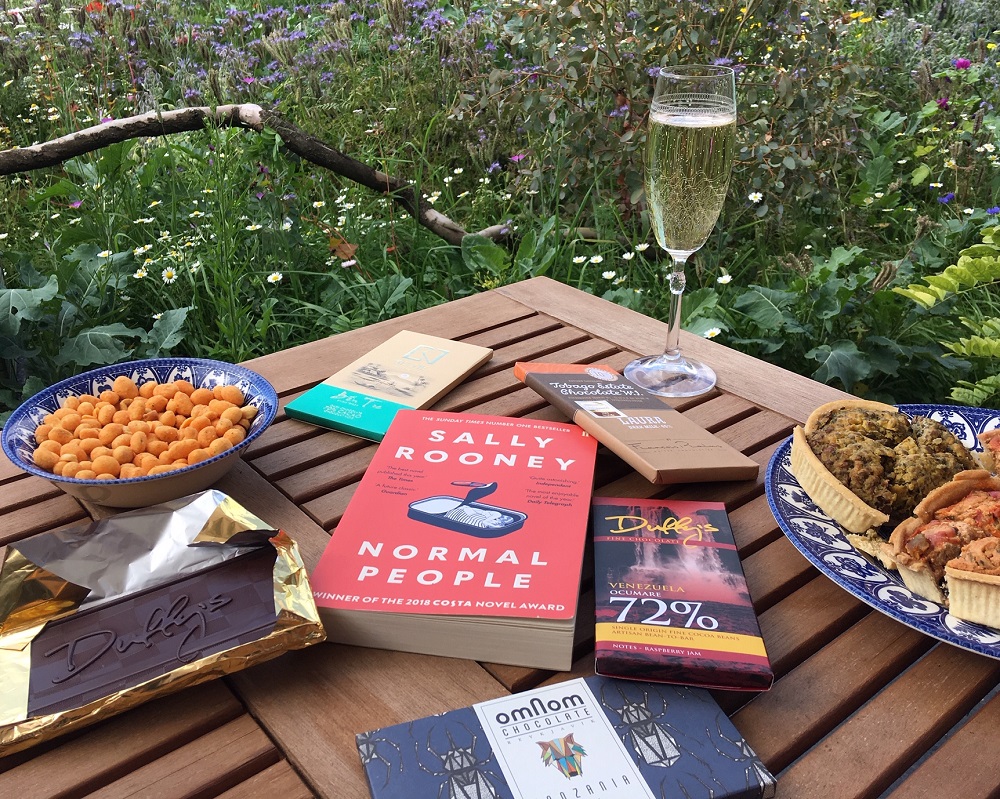
The Louth Literary Coven book club members met for their late summer craft chocolate and book pairing recently. To stimulate discussion and hopefully add to the overall enjoyment of the afternoon, I chose four bars to bring attention to the underlying themes of the novel.
On the basis that Rooney's Normal People encourages us to consider how her main characters, Marianne and Connell, are endeavouring to work towards a more equal relationship, where money and social capital are shared, I decided to do the same with my craft chocolate choices.
Our book discussion focused predominantly on the appeal and development of the characters and the intensity and frustration of their will-they-won't-they relationship. It was a great story and so well written. It was effortless, intense and a pleasure to read.
After our initial discussion we tasted the craft chocolate with bars selected to represent different models of fairer trade, and illustrate how craft chocolate makers are not just focusing on delivering a fine-flavour taste experience, but also on creating more equal trading relationships. These are the bars we tasted along with a brief overview of the group’s thoughts:
Our first book club craft chocolate pairing was the award-winning ‘Laura’ from the island of Tobago. A delicious bar with thick oozy caramel notes running into higher, sweeter honey notes and a Cadbury Eclair finish. A deliciously comforting bar made by Tobago based Duane Dove whose mission is to make chocolate with the best raw materials, completely free from exploited labour. Rather than selling beans to a European maker, Duane has the chocolate made for him by French experts, Pralus. A transparent and we presume, an equal partnership between grower and maker.
Next in our book club chocolate pairings was Belvie’s Ben Tre Vietnam. Originating from a Caribbean hillside plantation, where the cacao farmers work among the rice fields and water buffalo of Vietnam. A complex bar with flavours swinging gently between sweet and sour notes, made from beans purchased directly from the farmer and made from bean to bar in Vietnam. A better price for the farmers and the profits remaining in the country of origin
Continuing the book club pairings, we moved on to the chocolate of the Kokoa Kamili Cooperative farmers in the Kilombero Valley, on the edge of Tanzania’s Udzungwa Mountain National Park. This time made by Icelandic makers Omnom. A heavenly taste experience delivering peaks of fruitiness: lemon sherbet, yellow fruits, plums and sweet figs balanced with a luscious, chocolate brownie baseline. Purchasing beans from this community of growers brings real economic development to rural Tanzanian farmers.
The final of our book club chocolate pairings was Duffy's Venezuela Ocumare. This bar took us right back to the beginning of the story of Europe’s love affair with chocolate, and the growing of cacao being a contentious, political and often violent issue. The chocolate was full of character: sweet, sumptuous and enigmatic. Varying market structures and political pressures in the country of origin can create problems for direct trade. This is certainly the case with Venezuela.
The maker Duffy Sheardown is involved in the ‘Direct Cacao’ initiative. An association based on ‘respect, value and mutual benefit between cacao growers, chocolate makers and consumers, aiming to protect and preserve fine cacao’. But buying cacao is difficult in Venezuela as Duffy explained to me, “We cannot buy direct from Venezuela and have to use a wholesaler that we trust and that has a good reputation. We hope to go Direct Trade there at some point.”
Just like the book, the tasting had been an effortless, intense experience and the chocolate a pleasure to eat. The research on the makers and their trading relationships, however, made us look beyond the great taste experience and consider the politics of power and dependency and also encouraged the group to look again at our reading of Normal People and the possibility that this too was about power, not just love but a "Marxism of the heart". (Annalisa Quinn, www.theatlantic.com, April 19)
Through our book club chocolate pairings, we saw how Rooney had embedded politics 'closely and rigorously' (Annalisa Quinn) into her love story and how craft chocolate isn’t just about taste but how makers are also striving to move towards more equal trading relationships.
The result: a fabulous late summer gathering!
For our thoughts on the book’s themes and messages, as well as our full chocolate tasting descriptions and votes for our favourite bars, read the Louth Literary Coven’s full post on the Mainly Books and Chocolate blog here.
Further reading
For further reading on Normal People, the chocolate makers and the trade relationships in craft chocolate, these are some suggested links:
Review of Normal People by Annalisa Quinn https://www.theatlantic.com/entertainment/archive/2019/04/sally-rooneys-normal-people-review/586801/
Tobago Estate Chocolate https://www.tobagococoa.com/
Belvie, Belgium’s First Short-Chain Chocolate Made In Vietnam: “Fair Trade Is Marketing” http://www.belviechocolate.com/2017/02/11/belvie-belgiums-first-short-chain-chocolate-made-vietnam-fair-trade-marketing/
Omnom Chocolate: https://www.omnomchocolate.com/pages/our-ingredients
Kokoa Kamili: http://www.kokoakamili.com/about
Duffy's Chocolate: http://www.duffyschocolate.co.uk/
Direct Cacao Initiative: https://www.directcacao.org/
The Chocolate Journalist on Fair Trade: https://thechocolatejournalist.com/fair-trade-chocolate-debunking-the-myth/
Goodnow Farms on Fair Trade: https://goodnowfarms.com/blog/fair-trade-vs-direct-trade/


