Too hot to taste chocolate? Sit back and take the Appreciation of Fine Chocolate on-demand video course, a fascinating guide to the world of fine chocolate.
This is the second in a series of posts comparing industrial premium and craft chocolate, prompted by a request to explore the value of “single origin” in upmarket retailers like M&S (Marks & Spencer 2025).-
According to research, “75% of consumers think that single origin chocolate is more premium and more sustainable compared to standard chocolate.” (Barry Callebaut, 2025).But is it?
Let's compare bars from M&S and Solkiki Chocolatemaker, both made with beans from the single origin of Ecuador. We’ll look at what we know about the beans’ origin, their journey from farm to bar, and, most importantly, how that journey is reflected in the taste.
Confectionery chocolate: In our everyday chocolate, the origin of the cacao is often unknown, and largely irrelevant to most consumers.
Industrial premium chocolate: A step up in price indicating increased concerns about origin and sustainable production. These products are typically blends or come from unspecified origins—making single origin a valuable marketing opportunity.
Fine (or craft) chocolate: Origin and sourcing are at the heart of both the final product and maker’s process. The goal is to express the true flavour of the cocoa beans and highlight their unique character.
Founded in 1884, M&S is a well-known British own-brand retailer that works closely with suppliers to manufacture its products. Here’s what the company says about its cocoa beans:
“Cocoa is a very important ingredient for M&S. We use about 8,500 tonnes of cocoa bean equivalent each year to make over 1,000 products and are committed to ensuring all our cocoa is sourced responsibly to help secure our access to this vital ingredient in years to come as well as improving the lives of growers.” (Marks and Spencer, 2025)
According to M&S, it sources 100% of their cocoa beans for their branded products from “verified sustainable sources”. They are members of the International Cocoa Initiative, were the first retailer to invest in Fairtrade’s Child Labour Prevention and Remediation programme and are part of the Retailer Cocoa Collaboration (RCC) a group “committed to achieving zero deforestation and exploitation-free cocoa”. (Marks and Spencer, 2025)
You can download the RCC 2023 Annual Trader Assessment Results, prepared with input from NGOs Mighty Earth and VOICE Network, from their website. This makes interesting reading. It assesses the performance of the nine traders submitted by its members: BARRY CALLEBAUT, ECOM, OLAM, CEMOI, TOUTON, CASA LUKER, ICAM, CARGILL and FUCHS & HOFFMANN. (Cooper, Kitulagoda, Nelson, Preuss, & Schreiber, 2025). You may notice that there's just one family owned Italian supplier in there - ICAM!.
It highlights:
“Across all traders, we see sole focus on the direct portion of the supply chain, leaving risk hot spots for human rights abuses and deforestation within indirect supply.”
In short, M&S monitors and reports on its supply chain but even with the best intentions, its influence over deeper ethical issues within it remains limited.
By contrast, Solkiki Chocolatemaker are a small Dorset-based craft chocolate company founded by Iris Stork and Bob Spink who have been making their own chocolate since 2008.
Unlike large companies, craft makers like Solkiki demonstrate their values through the sourcing and processing of each and every bar – not through annual reports.
Their chocolate is dairy-free, handmade in small batches and their whole approach to sourcing and making is grounded in the principles of traceability, flavour, quality, nutrition and sustainability.

M&S Single Origin Dark Chocolate Ecuador 75% Cocoa (100g) Best Before: 08/04/2027. Online retail price via Ocado is £3.00 (£3.00/100g)
Solkiki Chocolatemaker Costa Esmeraldas, Ecuador 70% Cocoa (56g) –Best Before 03/27 Online retail price via Solkiki Chocolatemaker website £9.25 (£16.51/100g)
Price already signals which bar is fine and which simply fashionable—but let’s put them through the TTC test to find out more.
I use three easy-to-remember criteria to judge the quality of my chocolate: Taste, Transparency, and Craftsmanship (TTC). All three focus on what we know and can learn about the cocoa beans.

For the purposes of this post, I’ll discuss taste last, since we can often anticipate it by looking at the first two.
What do we know about the beans and how they’ve been made into chocolate?
M&S Single Origin Dark Chocolate
It’s labelled single origin, so we know the beans are from Ecuador—currently the world’s fourth-largest cocoa producer, accounting for around 6% of global production. The packaging boasts it is made from the “World’s Finest Cocoa,” yet offers no evidence to support this claim: no mention of bean genetics or specific region within Ecuador.
While Ecuador is home to some excellent cacao, the majority is sold as a commodity. In contrast, the finest cacao commands a much higher price and requires traceability to a specific farm or cooperative. We don't know the farmgate price but it is a Fairtrade bar and until 1/09/25 the minimum that can be paid for Fairtrade beans is 2,400 USD per metric tonne (2.4 USD/kg or *£1.75/kg ) with a premium of 240 USD per metric tonne (0.24 USD/kilo or *£0.18/ per kilo). (Fairtrade International (FLO), 2025)
The bars are produced for M&S by a company in Italy, described as “a third-generation family-owned chocolatier near Milan.” While this may sound artisanal, the maker is not named. The term “bean to bar” is also used, but without knowing the maker and given the size of M&S and the lack of transparency, it is safe to assume that this bean-to-bar production is industrial.
In summary: the beans are Fairtrade from Ecuador – a fashionable origin- but there is limited transparency. Only the taste will tell us if this bar lives up to its origin claim.
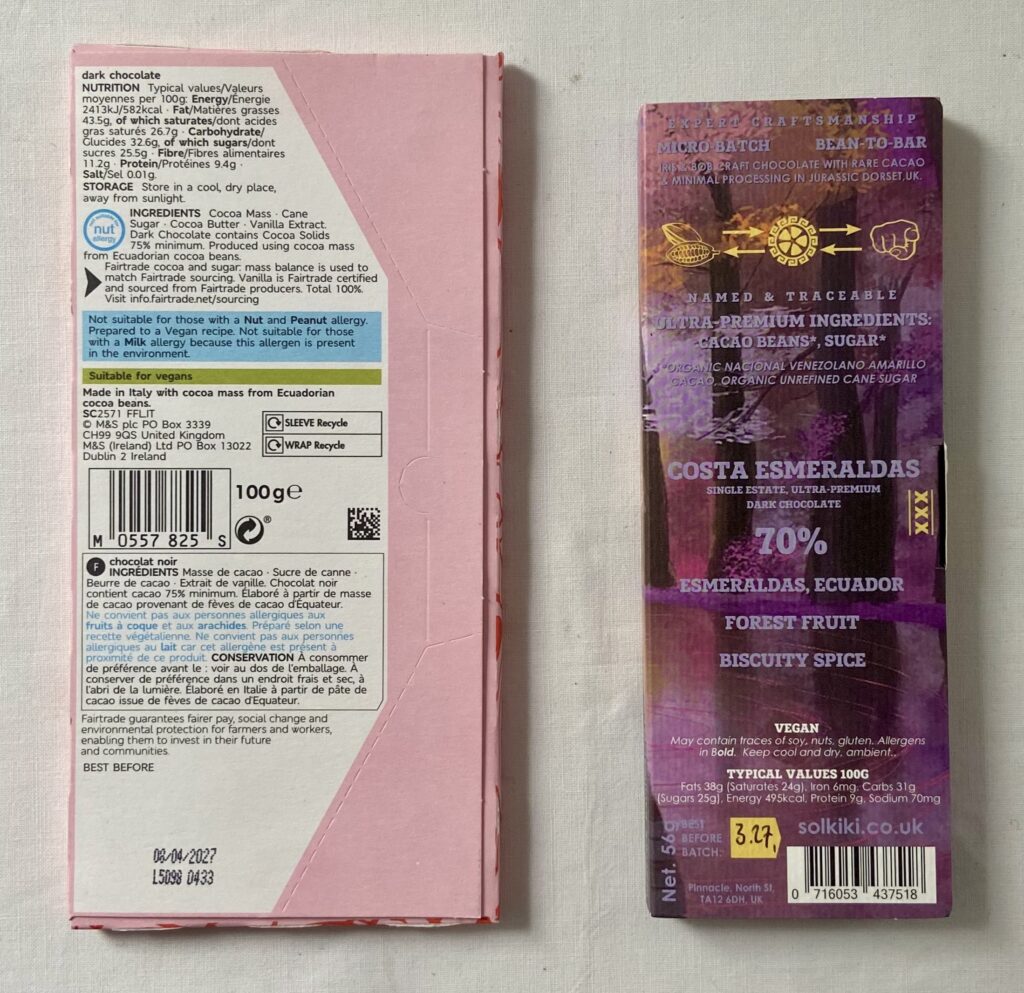
Solkiki Costa Esmeraldas Cloud Forest 70%
Single origin and single estate with a working relationship dating back to 2018. The beans are from the 100-hectare, family owned Costa Esmeraldas estate in Ecuador’s Esmeraldas province.
You can visit the Costa Esmeraldas Cacao Company website to learn about the people behind the company, its history, bean genetics, flavour potential and its Cocoa of Excellence award.
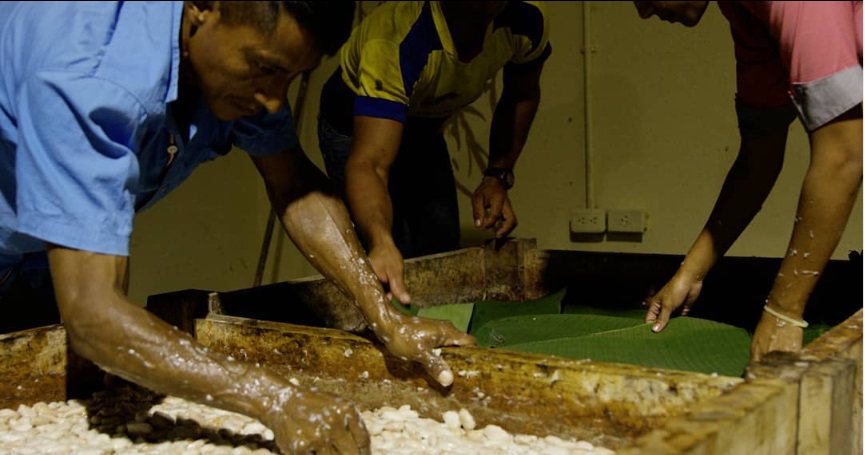
Exact farmgate prices aren’t published, but the trading relationship is direct, long-term, and quality-based. Solkiki confirmed by email that the current harvest price for Costa Esmeraldas beans is £16.50/kg. Even amid price volatility, that’s well above the price levels for commodity cocoa beans—and the Fairtrade premium remember, is less than 18p/kg. You can do the maths on the farmer’s behalf!
Solkiki makes chocolate from bean to bar, “handcrafting” in “micro-batches” and tempering each batch by hand. You can see stunning photos of Iris and Bob at their small makery featured in Home Made by Kate Humble, published last year.
Summary: Complete transparency regarding the singular origin of the beans.
How are the flavours crafted from the ingredients?
M&S Single Origin Dark Chocolate
We’re not told how the flavours of this “World’s Finest Cocoa” are developed—but vanilla extract is added. So, are the flavours crafted, or manufactured?
Solkiki Costa Esmeraldas Cloud Forest 70%
The beans were chosen for their flavour potential and their true-to-origin, accessible character.
We know they’re fermented for 5.5 days in cedro wood boxes, sun-dried, aged for 2 months, and undergo strict quality control (Costa Esmeraldas Cacao Company, 2025).
Solkiki applies its own roasting and conching profiles to bring out the natural character of the beans. The ingredients? 70% cacao, 30% sugar. No added cocoa butter. No vanilla.
How would you describe the taste experience?
M&S Single Origin Dark Chocolate
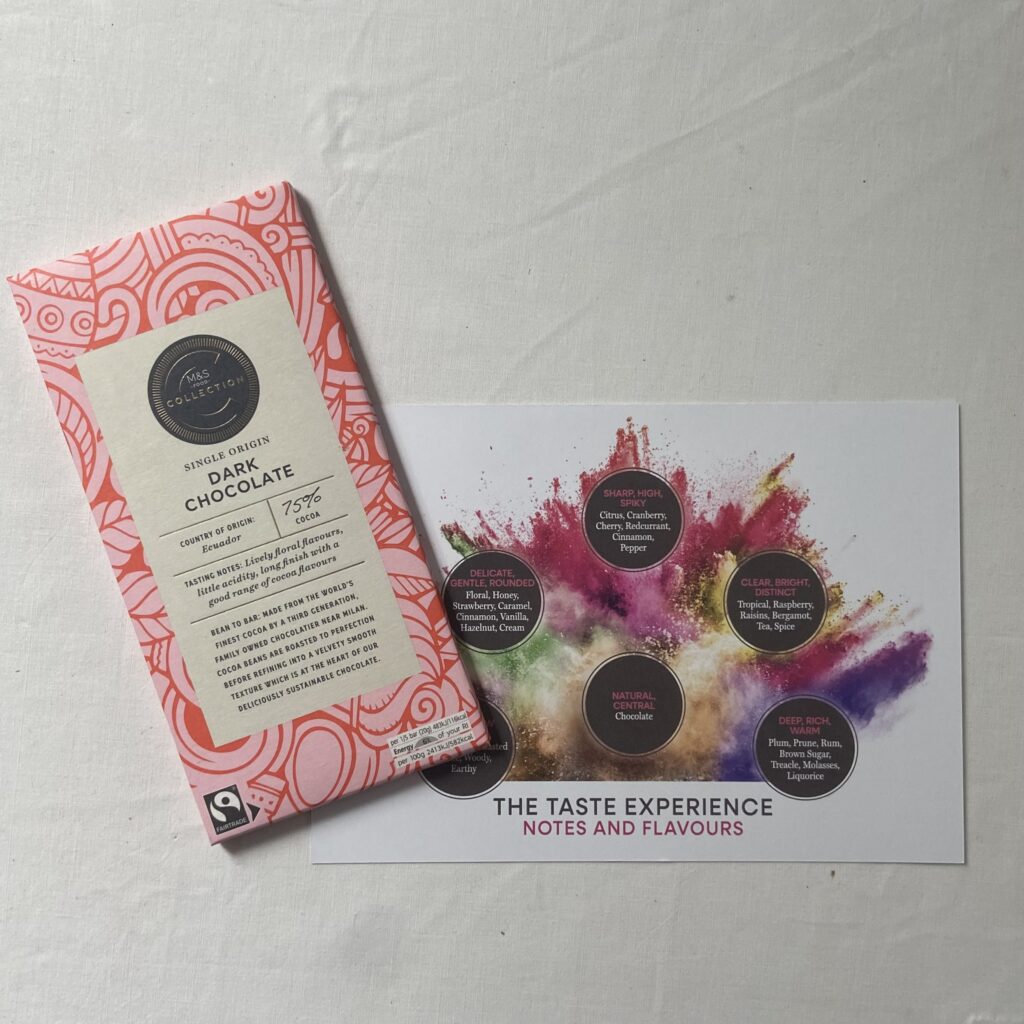
There’s a bold claim on the front of the pack: “Tasting Notes: Lively floral flavours, little acidity, long finish with a good range of cocoa flavours.”
Let me tell you what I taste.
The aroma is dominated by the vanilla with a hint of stale coconut in the background. The melt is somewhat reluctant then smooth when underway. On the palate I get a nose-wrinkling bitterness suggestive of cocoa powder, some coconut, bitter almond, a little sweet vanilla and a metallic aftertaste.
These are not the best beans Ecuador has to offer. The flavours are generic.
Solkiki Costa Esmeraldas Cloud Forest 70%

Solkiki suggest a taste experience of forest fruit and biscuity spices.
Even the aroma comparison says it all—one bar tells of industrial processing, the other sings fine cacao.
Notes of blackberry pie are enticing you in! The fruit and spice aromas alone make this bar irresistibly inviting.
Juicy blackberry leads the way, followed by cinnamon. The fruit evolves into plum and a hint of stewed apple. I also picked up floral honey and rich, satisfying chocolate notes, all building to a warmer, deeper finish.
Whatever flavours you detect, the complexity is undeniable—and it reflects the true potential and expression of some of Ecuador’s finest beans
Using our criteria—transparency, craftsmanship, and taste—it’s clear the M&S Single Origin bar is a fashionable, industrially produced premium chocolate. It’s Fairtrade-certified and attractively priced but offers little insight into the flavour complexity that truly fine Ecuadorian beans can deliver. It may look the part—but it shows that, despite being a clever marketing ploy, “single origin” alone doesn’t guarantee better chocolate
By contrast, Solkiki’s Costa Esmeraldas bar sets a different standard: fully transparent, traceable to a single estate, and handcrafted to bring out the best in the beans.
It’s the story behind the origin of the beans that matters—and truly fine chocolate brings that story to life through taste, as our Solkiki bar illustrates.
Curious to learn how to identify genuinely fine and crafted chocolate? Explore my micro-learning course: An Appreciation of Fine Chocolate.
*Calculation based on https://wise.com/gb/currency-converter/usd-to-gbp-rate 30 day average 30/6/25
Barry Callebaut, 2025. Why is origin so important. [Online]
Available at: https://www.barry-callebaut.com/en-GB/trends-insights/why-origin-is-so-important
Cooper, H. et al., 2025. RCC Report 2023. [Online]
Available at: https://retailercocoacollaboration.com/wp-content/uploads/2024/06/rcc_report_2023.pdf
Costa Esmeraldas Cacao Company, 2025. Post-harvest. [Online]
Available at: https://costaesmeraldas.com/#post-harvest
Fairtrade International (FLO), 2025. Fairtrade Minimum Prices and Premiums. [Online]
Available at: https://www.fairtrade.net/content/dam/fairtrade/global/minimum-price-table/2025-04-29_Fairtrade_Minimum_Price_and_Premium_Table_EN_PUBLIC.pdf
Fairtrade, 2025. Fairtrade Risk Map. [Online]
Available at: https://riskmap.fairtrade.net/commodities/cocoa
Marks and Spencer, 2025. Cocoa Sustainability. [Online]
Available at: https://corporate.marksandspencer.com/sustainability/our-products/food-raw-materials/cocoa
Retailer Cocoa Collaboration, 2025. Home Page. [Online]
Available at: https://retailercocoacollaboration.com/
Solkiki Chocolate Maker, 2025. ABout. [Online]
Available at: https://www.solkiki.co.uk/
Uncommon Cacao, 2025. Lachua. [Online]
Available at: htts://www.uncommoncacao.com/pages/lachua


